Introduction:
Low land refers to agricultural land situated in low- lying areas where water trends to accumulate due to poor drainage, high rainfall, or its position in the landscape. Such lands generally have higher soil moisture and may remain waterlogged for part of the growing season. Lowlands are commonly used for crops that can tolerate excess moisture, particularly rice (paddy).
Low land farming is important for agricultural production because these areas often receive or retain sufficient water for crop growth. However, waterlogging, poor aeration, nutrient loss, and drainage problems can limit crop productivity. Proper water and nutrient management is therefore essential for successful cultivation in lowland area. https://www.britannica.com/plant/taro-plant
Table of Contents
Taxonomy:
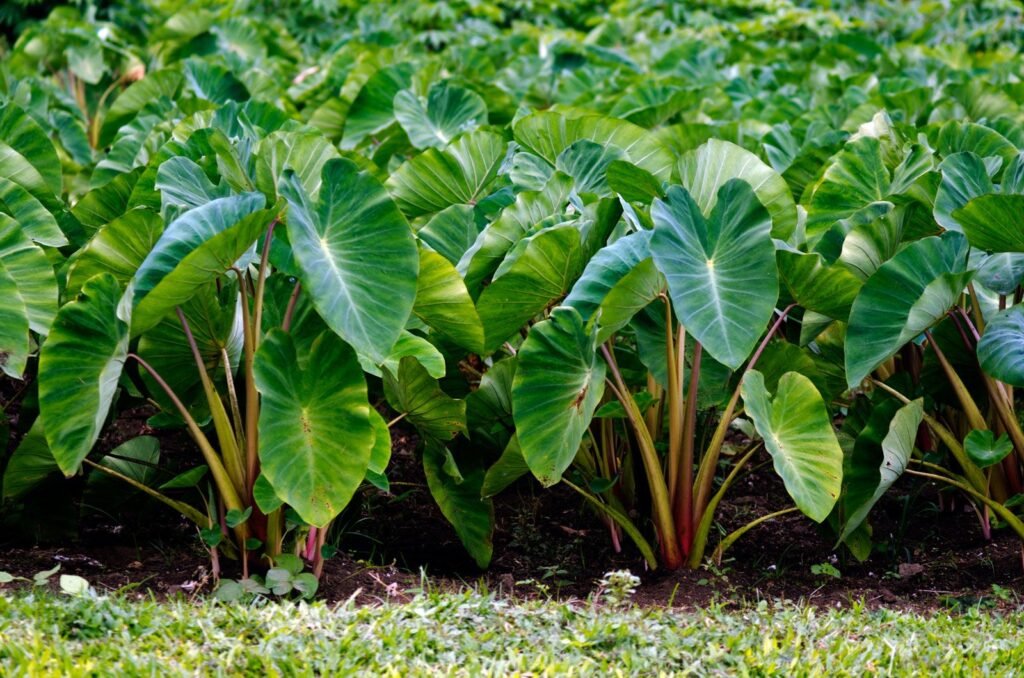
Swamp Taro
- Botanical name: Colocasia esculenta var. stolonifera
- Family: Araceae
- Chromosome number: 2n = 2x = 28
- Origin: South East Asia (probably India or Malaysia)
- Edible Part: Stolon
Giant Swamp Taro
- Botanical name: Crystosperma chamissonis
- Family: Araceae
- Chromosome number: 2n = 2x = 28
- Origin: South East Asia
- Edible part: Stolon, petiole and sucker corm
- Swamp taro produce many stolons from the developing sucker, which are the main edible parts, while giant swamp taro hardly produces any stolon but the whole plant including the sucker corm is edible.
- The plant contains calcium oxalate crystals which cause an extremely unpleasant sensation similar to needles being struck into the mouth and tongue if they are eaten but they are easily neutralized by thoroughly drying or cooking the plant or by steeping it in water.
Botany:
- A mature swamp taro and giant swamp taro plant may reach 1 – 1.5 m and 2-3 m in height.
- Swamp taro produce profuse stolons but giant taro is a shy bearer of stolon.
- The inflorescence has a long, thick yellowish spathe and a purplish spadix, though the seeds are often not fertile.
- The stem thickness at the base becoming a large corm varying in shape from cylindrical to conical to almost spherical.
- The size of the corm of about 15-25 kg is common but it can weigh upto 90 kg or more in a 10 year old plant.
Variety:
| Sl No. | Variety | Salient Features | Institute/ University |
| 1 | BCST – 13 | Recommended for low land/swamy areas; Average yield: 24-26 t/ha; Commercialized in West Bengal and Assam. | BCKV, West Bengal |
Climate:
- Low land taro is well adapted to moist tropical climates.
- A climate where precipitation exceeds evapotranspiration on an annual basis.
- It can tolerate maximum temperature of 35-38 ⁰C.
- Swamp taro can withstand a minimum monthly mean temperature of about 15.5 ⁰C.
Soil:
- Giant swamp taro and swamp taro are water loving plant adapted to fresh to brackish water conditions in coastal marshes natural and man-made swamps and pit depressions.
- A more or less continuous supply of water is essential.
- Ideal growing conditions are natural swamp land rich in humus.
- The pH of the topsoil is 4.5-5.5 and subsoil is 5.6-6.5 respectively.
Land Preparation:
- In wet land taro cultivation the most common feature is puddle soil after soaking for fee days and left undisturbed to allow the soil for settling.
Propagation:
Suckers (sprouting corms) are the commonest planting material although sometimes the top of the corm (setts) with about 30 cm of petiole of the harvested plant is used.
Planting time:
December to January is ideal.
Planting method:
- The simplest system can be found in the freshwater marshes of high islands.
- In this method, the marsh is cleared of its vegetation and then the setts are planted.
- Mulching should be provided until the plants are 1-2 m high.
Harvesting:
- The production of stolons of swamp taro starts three months after planting.
- When the length of the stolon reaches 90-100 cm, it is ready to harvest.
- The stolon reaches its peak in the month of July and continues up to October.
Yield:
The yield of stolons of swamp taro and sucker corms of giant swamp taro varies from 20-25 t/ha.