Introduction:
Agriculture extension is an educational and advisory service that helps farmers improve their knowledge, skill, and farming practices. It serves as a bridge between agricultural research institutions and farmers by transferring modern technologies, scientific innovations, and practical information to enhance agricultural productivity and rural livelihoods.
The main goal of agriculture extension is to improve farm production, increase farmer’s income, ensure food security, and promote sustainable agricultural practices. Extension workers educate farmers on improved crop production, livestock management, pest and disease control, soil conservation, irrigation techniques, and the efficient use of agricultural inputs. They also provide guidance on marketing farm management, and climate – smart agriculture.
Agricultural extension methods include farm visits, demonstrations, farmer field schools, group meetings, training workshops, radio and television programs, mobile phone services, and digital platforms. These methods enable farmers to access timely and relevant information, helping them make informed decisions. https://en.wikipedia.org/wiki/Agricultural_extension
Extension:
Derived from following two Latin words.
- Ex = Out
- Tensio = Stretching
- Means stretched out to people in the rural areas.
- Extension term was originated in England in 1866.
- Extension education term was first used in 1873 by Cambridge university.
Table of Contents
Definations:
- The National Commission on Agriculture (1976) refers to extension as an out school education and services for the member of the farm family and other directly or indirectly engaged in farm production to enable them to adopt improved practices in production, management, conservation and marketing.
- The fundamental objective of extension is to develop the rural people economically, socially and culturally through education.
Principles of extension:
- Principles of cultural awareness.
- Grassroot principle.
- Principles of indigenous knowledge.
- Principle of learning by doing.
- Principle of participation.
- Family principle.
- Principle of leardership.
- Principle of adaptability.
- Principle of satisfaction.
- Principle of evalution
- Principle of empowerment.
Levels of extension:
- Extension education – Main aim to create extension professional agencies i.e. agricultural universities, research institutes, apex training centres educate, train and develop professionals for teaching and do research in extension and develop professionals for extension services.
- Extension service – The primary responsibility of extension service is with the State government. The development of agriculture and associated branches of the state government carry out extension work with the farmers and rural people over the entire state.
Functions of extension:
The main function of extension is to bring about desirable change in the human behaviour by means of education. Changes may be brought about in rural peoples knowledge, skill, attitude, understanding, goals, action, and confidence.
Education: Production of desirable changes in human behaviour through gaining desirable knowledge, attitude and mental/manual skill is called as education.
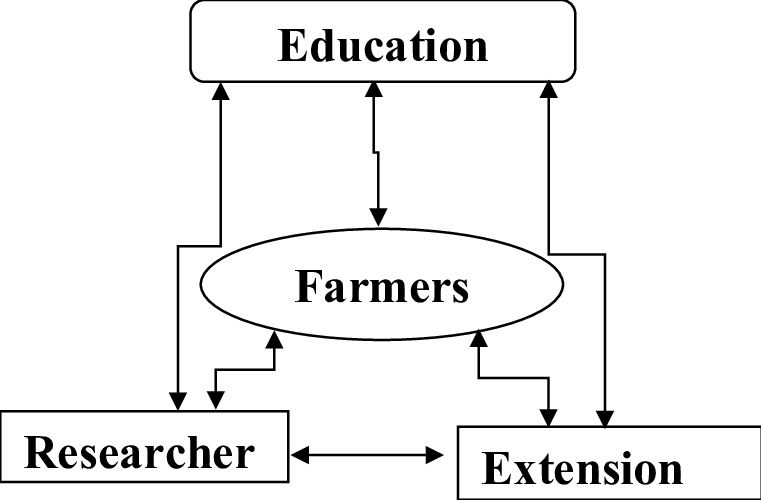
Types of education:
- Formal education – It is highly institutionalized, chronologically graded and hierarchically structured education system e.g. school, college education. Learners are homogenous and confident to the premises of education institute with top down ( vertical) flow of information.
- Non – formal education – Extension education is a non formal education. Learners are heterogenous and helps people’s to face actual life situations outside the educational institutions.
- Informal education – It is life long process and happens in everyday life. Self learning is the characteristic feature of informal learning.
Extension education process:
According to Dr. J.P Leagans (1967) ‘Extension Education’ process involves five steps (SOTER).
- Situation
- Objective
- Teaching
- Evalution
- Reconsideration
Steps in Extension Teaching- remember tricks ‘AIDCAS’
According to Wilson, MC and Gallup, 1955 the six steps in effective extension teaching are (AIDCAS).
- Attention
- Intrest
- Desire
- Conviction
- Action
- Satisfaction
Adoption and diffusion of innovations: remember tricks ‘AIETA’
- Adoption is a – Mental process.
- Adoption is a decision to make full use of an innovation as The best course of action available. Or adoption refers to the stage in which an individual select a technology for use.
- Diffusion – is the process by which an innovation is communicated through certain channels over time among the members of a social system.
- According to Hamberg five stage of adoption process –
- Awareness
- Intrest
- Evaluation
- Trial
- Adoption