Introduction:
Plant breeding is the science and art of improving plants to develop new varities with desirable characteristics. It involves selecting and crossing plants with superior traits, such as higher yield, better quality, resistance to diseases and pest, tolerance to environmental stresses, and improved nutritional value. The main objective of plant breeding is to enhance crop productivity and ensure food security while meeting the needs of farmers, consumers, and industries.
Plant breeding has been practiced since the beginning of agriculture through the selection of the best- performing plants. Modern plant breeding combines traditional methods with advanced techniques such as hybridization, mutation breeding, molecular markers, tissue culture, and genetic engineering to produce improved crop varieties more efficiently.
Overall, plant breeding plays a vital role in sustainable agriculture by increasing crop performance, improving resilience to climate change, and contributing to the economic development of the agriculture sector.
Table of Contents
Objectives of Plant Breeding:
- Higher and stable yield.
- Better quality and nutritional value.
- Resistance to insect and diseases.
- Tolerance to drought, salinity, heat, cold, and other stress.
- Early or suitable maturity.
- Better adaptation to different environments.
- Improved agronomic characteristics.
- Better suitability for processing and storage
Plant breeding combines knowledge from genetics, cytology, plant physiology, botany, statistics, biotechnology, and agronomy.
Definition of plant breeding:
B.D. Singh: Plant Breeding is the art and science of changing and improving the heredity of plants.
Allard: Plant breeding is the art and science of changing the heredity of plants for the benefit of mankind.
Importance:
Plant breeding is important because:
- Increases crop productivity.
- Improves food and nutritional security.
- Develops disease and pest resistance varieties.
- Helps crops tolerate climate related stresses.
- Improves quality of agricultural products.
- Reduces production costs.
- Improves resource use efficiency.
- Provides varieties suited to different agro climatic regions.
- Supports mechanized agriculture.
- Increases farmer’s income.
Basic principles of plant breeding:
Plant breeding is mainly based on four fundamental principles:
- Creation of genetic variation: Variation may be obtained through. Introduction, hybridization, mutation, polyploidy, and genetic engineering.
- Selection: Superior plants are identified and selected from a variable population.
- Evaluation: Selected plants or lines are tested for their performance.
- Release and multiplication: The best line is released as a variety and multiplied for distribution to farmers.
Important terms in plant breeding:
Germplasm: The total genetic material available in a species or crop is called germplasm.
Variety: A group of plants having distinct, uniform, and stable characteristics.
Cultivar: A cultivated variety produced or maintained through human selection.
Genotype: The genetic constitution of an individual.
Phenotype: The observable characteristics of an individual resulting from genotype and environment.
Selection: The process of choosing superior individual from a population.
Hybrid: The offspring produced by choosing two genetically different parents.
Pure line: Progeny obtained from a single homozygous self – pollinated plant.
Inbreed line: A nearly homozygous line developed through repeated self – pollination.
Heterosis: The superior performance of an F1 by hybrid compared with its parent.
Sources of Genetic Variation:
Genetic variation is essential for plant breeding.
Major sources include:
A. Introduction: Introduction means bringing a crop or genotype from one geographical region to another.
Types: Primary introduction, and secondary introduction.
B. Hybridization: Hybridization is the crossing of two genetically different plants to combine desriable characters.
Types of hybridization:
- Intervarietal hybridization: Crossing between two varieties of the same species.
- Interspecific hybridization: Crossing between different species of the same genus.
- Intergeneric hybridization: Crossing between plants belonging to different genera.
C. Mutation breeding: A mutation is a sudden heritable change in the genetic material.
D. Polyploidy breeding: It refers to the presence of more than two complete sets of chromosomes.
https://hortigyan.com/wp-admin/post.php?post=101&action=edit
E. Clonal selection : Superior plants are selected and propagated vegetatively.
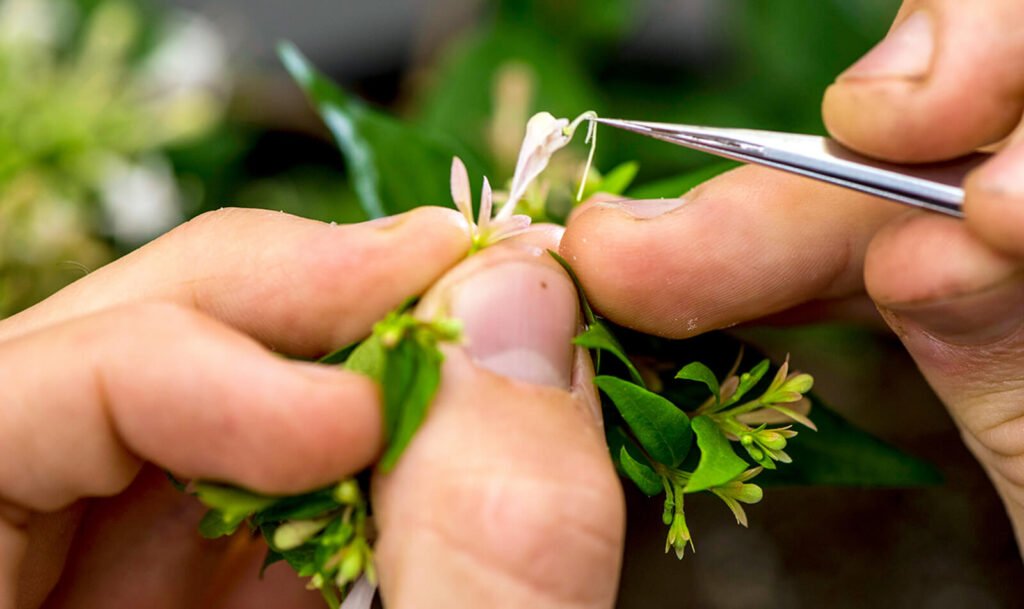
F. Emasculation: It is the removal of anthers from a bisexual flower before pollen shedding.