Rose preservation means maintaining the shape, colour, texture and beauty of rose flowers after harvest for a long period. It is useful for floral crafts, bouquet, wedding memories, decoration, herbarium work, research and commercial products.
For roses, the preservation method should be selected according to the desired final product: natural-looking dried rose, pressed rose, soft preserved rose, or long- term premium preserved rose.
Table of Contents
Objectives of Rose Preservation:
- To extend the useful life of roses.
- To retain colour, shape and appearance.
- To reduce post-harvest losses.
- To prepare flowers for decoration and crafts.
- To preserve flowers for special occasions.
- To produce dried flowers for commercial purposes.
- To maintain ornamental value for a longer period.
Important Principles:
Successful rose preservation depends mainly on:
- Correct harvesting stage.
- Healthy, disease-free flowers.
- Proper sanitation
- Rapid removal of excess moisture
- Protection from direct sunlight
- Controlled temperature and humidity
- Appropriate preservation technique
- Proper storage after preservation
Fresh flowers should ideally be handled quickly after harvest because water loss and microbial contamination reduce flower quality.
Harvesting of Roses for preservation:
Best time
- Harvest preferably in the early morning.
- Flowers should be dry and free from dew.
- Select healthy, undamaged flowers.
- Avoid flowers showing Botrytis, bruising, brown spots or petal damage.
Suitable flower stage: For drying, select roses that are:- Fresh, firm, fully developed but not over-mature, free from insect and disease damage.
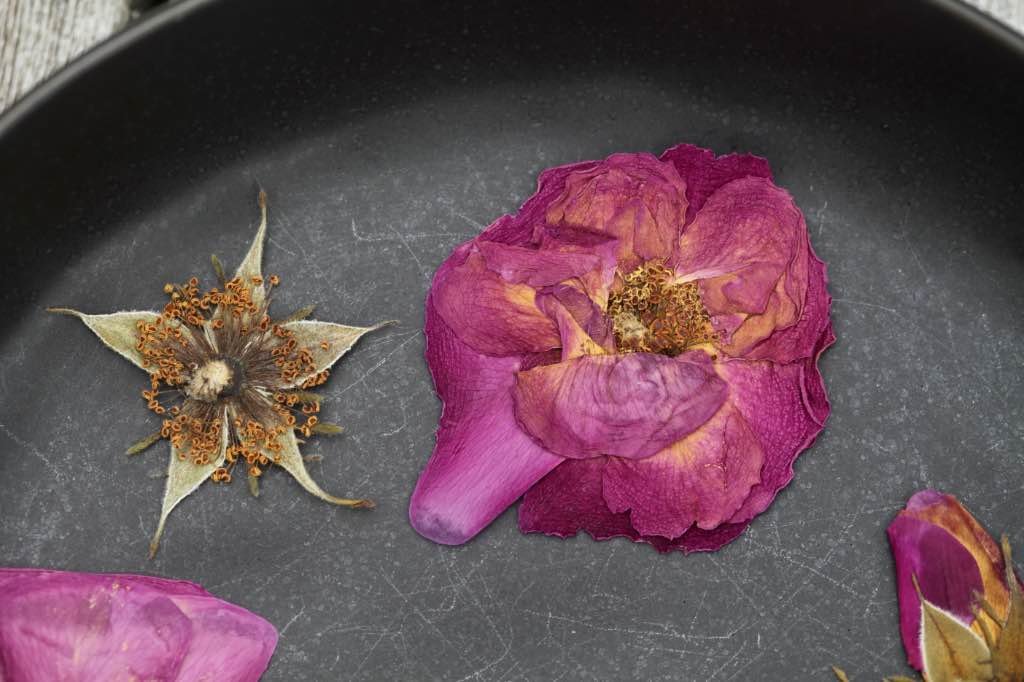
Major methods of rose preservation:
| Method | Main Purpose |
| Air drying | Simple dried roses |
| Press drying | Cards, frames, herbarium |
| Silica-gel drying | High-quality dried flowers |
| Sand drying | Traditional drying |
| Glycerin preservation | Foliage/soft plant material |
| Freeze drying | Premium preservation |
| Microwave drying | Rapid drying |
| Chemical preservation | Commercial use |
| Vase preservation | Extending fresh flower life |
Air-Drying Method:
This is the simplest and cheapest method.
Procedure:
- Select healthy roses.
- Remove damaged petal and excess leaves.
- Tie stems into small bunches.
- Hang the flowers upside down.
- keep them in a dry, dark, well ventilated place.
- Avoid direct sunlight
- Allow flowers to dry completely.
- Spray a suitable protective coating if required.
- Store in a dry container.
Silica-Gel Drying:
Silica gel is one of the best materials for drying delicate flowers because it removes moisture rapidly and can preserve flower colour and shape relatively well. Drying commonly takes about 2-7 days, depending on the flower and conditions.
Materials:
- Fresh rose
- Silica gel
- Airtight container
- Soft brush
- Scissors
- Florist wire, if required
Procedure:
- Select a fresh, dry rose.
- Remove unwanted leaves.
- Put a layer of silica gel at the bottom of an airtight container .
- Place the rose carefully on the silica gel.
- Slowly cover the flower with silica gel.
- Make sure silica gel reaches between the petals.
- Close the container tightly
- Leave for approximately 2-7 days.
- Carefully remove the flower
- Brush away remaining silica gel gently.
- Store in a dry place.
Pressing of Roses:
Pressing is ideal when you want a flat preserved rose.
Procedure:
- Select a fresh rose.
- Remove excess moisture.
- Separate petals if necessary.
- Place the flower between adsorbent paper.
- Put it inside a heavy book or flower press.
- Put is inside a heavy book or flower press.
- Apply uniform pressure.
- Replace damp paper when necessary.
- Allow approximately 7-10 days for pressing.
- Remove carefully and mount on paper/card.
Glycerine Preservation:
Glycerine preservation is particularly useful when the objective is to maintain flexibility and a soft, leathery texture rather than producing a completely dry flower.
For a naturally beautiful, three-dimensional preserved rose, silica-gel drying is usually the most practical choice; for the highest quality long term preservation, freeze drying gives a normal preservation.
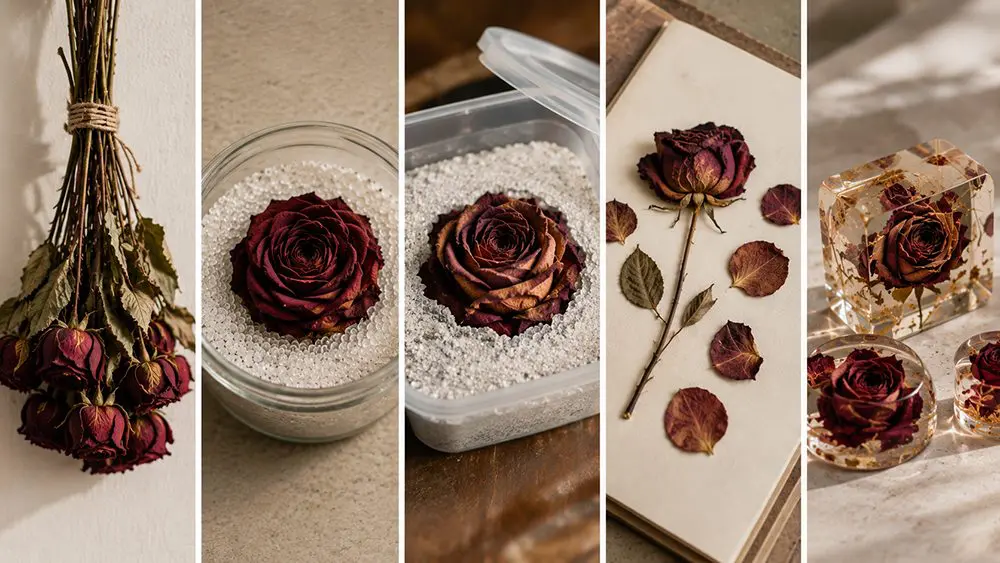
Rose Preservation
https://agritech.tnau.ac.in/horticulture/horti_flower%20crops_commercial%20rose.html