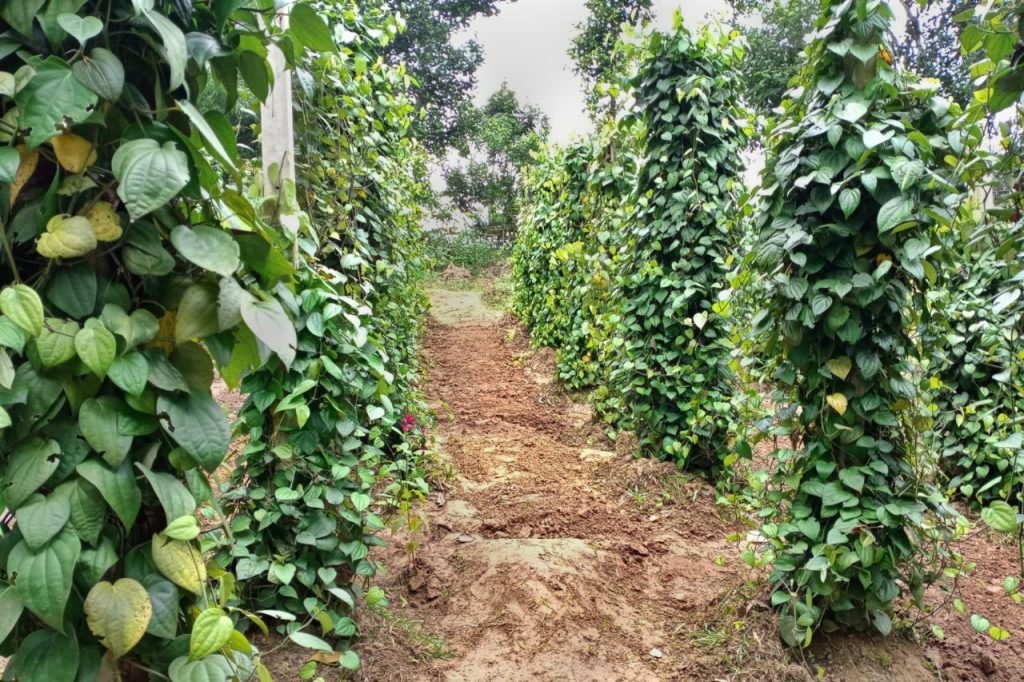
Introduction:
Black pepper (Piper nigrum L.) is one of the most important spice crops of the world and is commonly known as the “King of Spices”. It belongs to the family Piperaceae.
Table of Contents
Taxonomy:
- Botanical name: Piper nigrum
- Family: Piperaceae
- Chromosome number: 2n = 2x = 52
- Origin: Western Ghats of South India
- Nature: Perennial climbing vine
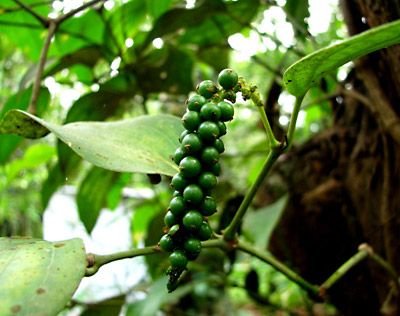
- Economic part: Dried berries
- Pollination: Mostly self-pollinated
- Propagation: Mainly vegetative
- Important alkaloid: Piperine
Climate:
Black pepper prefers a warm, humid tropical climate.
Ideal conditions:
- Temperature: approximately 23-32 ⁰C.
- High relative humidity
- Well-distributed rainfall
- About 2000-3000 mm
- It does not tolerate prolonged drought or waterlogging.
- Drainage is extremely important because excess water flavors disease such as phytophthora foot rot.
Soil:
- Best soils deep, fertile, well-drained, organic-matter rich, loamy/red laterite soil are suitable.
- Avoid waterlogged soils, very heavy compact soils, poorly drained lowlands.
- Slightly to moderate slopes are particularly useful because they improve drainage.
Varieties:
Important varieties
- Panniyur-1
- Panniyur-2
- Panniyur-3
- Panniyur-4
- Panniyur-5
- Sreekara
- Subhakara
- Panchami
- IISR Thevam
- IISR Girimunda
Panniyur-1 is historically important and was the first hybrid developed through the AICRP network.
Newer variety to remember:-
IISR Chandra: Released in 2023, early maturing, vigorous in nature, high yielding, long spikes, developed from HP 1117 × Thommankodi
Propagation:
- Black pepper is mainly propagated vegetatively by stem cuttings.
- Painting material used are healthy, high yielding, disease free mother vines
- A good method is to make 2-3 mode cuttings and root them in a nursery before field planting.
- Rooted cuttings improve establishment compared with directly planted cuttings.
Nursery management:
- Well drained soil.
- Partial shade.
- Regular moisture
- Disease free planting material
Support/Standard tree:
- Black pepper is a climber, so it needs a support. Common standards used are gliricidia, erythrina, silver oak, coconut etc. The pepper vine is trained uupward on the support.
- Tie vines to the standard.
- Remove unwanted shoots.
- Regulate shade.
- Lop branches of the standard when necessary.
Planting:
- Approximately 50×50×50 cm pit is used.
- Pit is made about 30 cm away from the base of the support tree.
- Planting is generally done with the onset/after the monsoon when soil moisture is adequate.
- Spacing depends on the support tree, system of cultivation, and soil and climate.
- For conventional plantation, around 2.5-3 m between standards is commonly used.
Training and Pruning:
- After planting:-
- Train in the vine along the standard.
- Allow climbing shoots to establish.
- Manage runner shoots.
- Remove excess/unwanted growth.
- Maintain appropriate shade.
- Runner shoots should not be allowed to spread excessively on the ground.
Manure and fertilizer:
- A commonly cited nutrient recommendation is: NPK 50:50:50 g per vine/year.
- 1st year: 1/3 dose.
- 2nd year: 2/3 dose.
- 3rd year onwards: full dose
- Usually applied in two split doses, around May-June-August-September.
- Organic manure applied are need cake, vermicompost, biofertilizers.
- Well decomposed FYM.
Irrigation:
- Black pepper is often grown under rainfed conditions.
- During dry periods give supplemental irrigation.
- Drip/micro-irrigation can be used.
- Mulching helps conserve moisture.
Mulching:
Mulch around the vine using dry leaves, straw, organic residues, compost material. Benefits are it conserves moisture, controls weeds, reduces temperature fluctuations and adds organic matter.
Weed management:
Regular hand weeding, mulching, cover crops where required and intercultural operation
Harvesting:
- Black pepper starts bearing after establishment, with full commercial production developing over subsequent years.
- Harvesting stage for black pepper: Harvest when one or few berries on the spike begin to turn yellow/ orange, while most berries are still green.
- Harvesting stage for white pepper: Berries are harvested at a more advanced stage of maturity and the outer pericarp is removed
Post -harvest processing:
Harvest- threshing – cleaning – blanching – drying – grading – storage.