Introduction
Water is the most important constituent of plant cells, making up about 80-95% of the fresh weight of actively growing tissues. It is essential for almost every physiological and biochemical process in plants. Water is absorbed mainly by the roots from the soil and transported to different parts of the plants through xylem.
The study of the relation of water deals with how plants deals with how plants absorb, transport, use, and lose water. This includes process such as water absorption, osmosis, diffusion, transpiration, water potential, and movement of water with plant tissues.
Water plays a vital role by:
- Acting as a solvent for mineral and nutrients.
- Serving as a raw material in photosynthesis.
- Maintaining cell turgidity and plant rigidity.
- Regulating plant temperature through transpiration.
- Helping in the transport of nutrients and food.
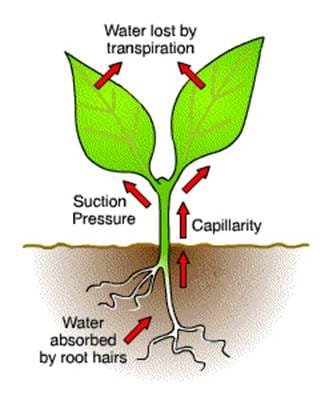
Absorption of water by plants
- The absorption of water takes place in the terminal portion of the roots i.e. root hairs.
- Root hairs are more developed in xerophytes and absent in hydrophytes.
Types of Absorption
- Active absorption: Water is absorbed due to activities of roots and metabolic energy spends in non osmotic active absorption. Only a small portion of water is absorbed by active absorption.
- Passive absorption: Passive absorption is controlled by activities of areal parts i.e. shoos, leaves of plants due to pressure exerted by transpiration, hence energy is not required, Plant absorbs most of water by passive absorption.
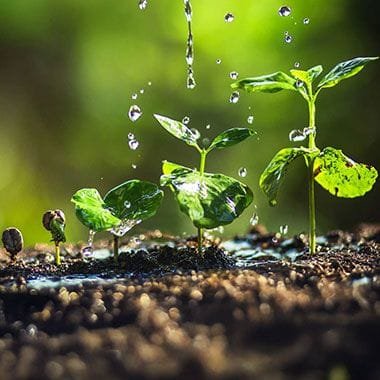
Ascent of cell sap:
The upward movement of water from stem base to tree top is called ‘ascent of cell sap’.
Mechanism of ascent of sap:
- Vital theories:
- Relay or clambering pump theory: given by Godlewski 1884.
- Pulsation theory: given by Sir J.C. Bose 1923.
- Root pressure theory:
- It coined by Stephan Hales 1727.
- The hydrostatic pressure developed dur to the accumulation of water absorbed by roots called root pressure.
- It is measured by manometer.
- Physical theories:
- Capillary theory: Boehm 1809: He stated that water rises in narrow tubes due to surface tension.
- Imbibitional theory: According to Sachs 1878, imbibition activity of cell walls of xylem is responsible for ascent of sap.
- Cohesion and Adhesion theory/ transpiration pull theory:
- This theory was propounded by Dixon and Jolly 1894.
- This theory is most accepted theory.
Loss of water in plants:
- Transpiration:
- The loss of water in the form the living aerial parts of the plant in the form of water vapour is termed as transpiration.https://cid-inc.com
- Transpiration is a necessary evil.
- It cooled down the leaf surface of the plants.
- Nearly 99% of the water absorbed by the plants is lost in transpiration.
- It is a vital and unavoidable phenomenon of plants.
- Transpiration is regulated by stomata activities.
- The principle organ of transpiration is leaf.
- Again foliar transpiration is of two types’ viz. Stomatal (80-90%) and Cuticular (up to 20%).
- Stomata:
- These are specialized epidermal cells which are distributed all over leaves, but in case of terrestrial plants, mainly on lower surface of leaves, therefore approx. 97% of transpiration takes place from the lower surface in such plants.
- Each stomata has two kidney shaped guard cell, inner wall of guard cell is thick and outer wall is thin.
Mechanism of stomata opening and closing:
- Opening and closing of stomata are dur to its turgidity and flaccidity respectively. Means stomatal movement is governed by Turgor pressure.
- When T.P of guard cells increases, stomata are opened and when decreases, stomata are closed.
- Rate of transpiration ids determined by Photometer.
Guttation:
- Term is given by Burgerstein.
- The exudation of water with salt and minerals through hydathode is called Guttation.
- Hydathode: a structure present at the tips of veins of leaves.
- It is caused due to root pressure.
- Guttation occurs mainly at night.https://hortigyan.com/, https://hortigyan.com/water-relation-in-plants/