Climate: It refers to the long term average weather pattern of a region over many years. It includes temperature, humidity, rainfall, wind and atmospheric pressure. Climate influences agriculture, ecosystems, and human life.
Weather: A sate or condition of atmosphere at a given place and at a given time. It describes what is happening outside, such as whether it is hot or cold, sunny or cloudy , windy, rainy or snowy. Weather changes over hours or days because of differences in temperature, air pressure, and moisture in the atmosphere.
The main elements of weather are:
- Temperature – How hot or cold the air is.
- Humidity – The amount of water vapor in the air.
- Air pressure – The force exerted by the air.
- Wind – Moving air caused by pressure differences.
- Clouds – Formed when the water vapor condenses.
- Precipitation – Rain, snow, sleet, or hail.
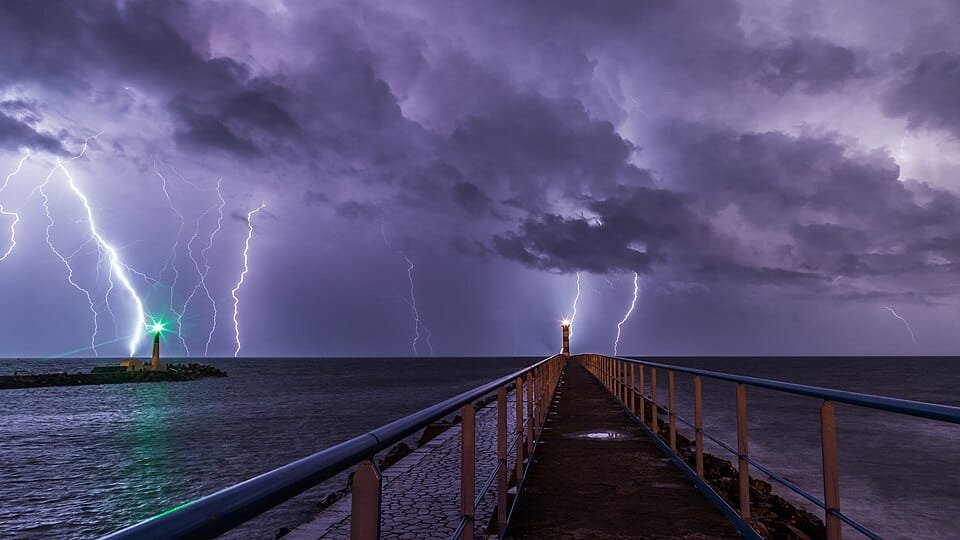
Atmosphere
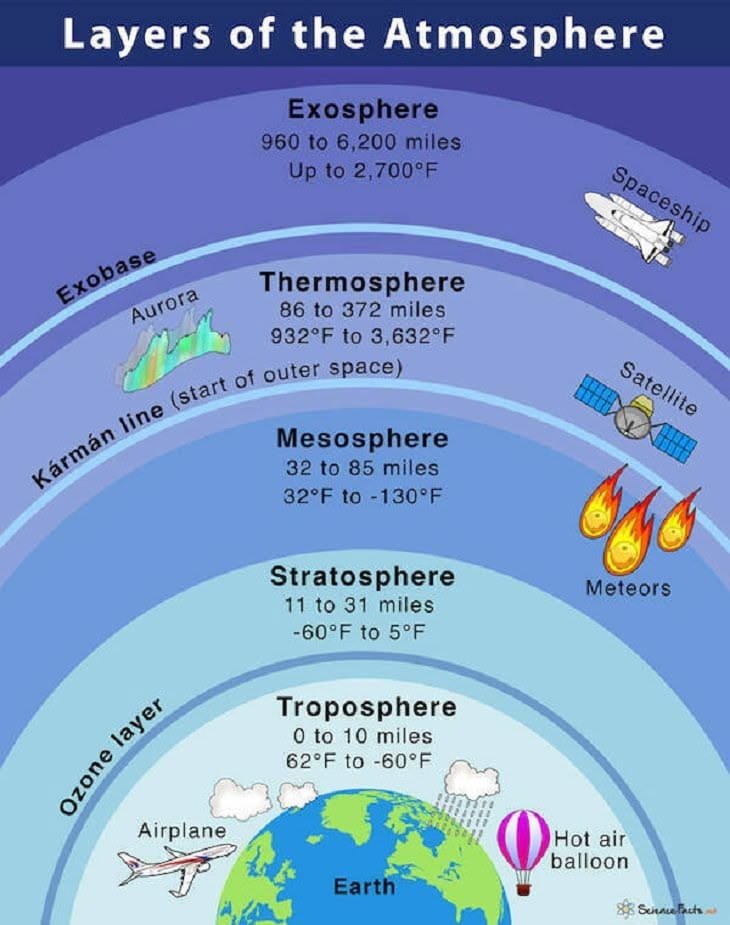
- It is colorless, tasteless, and odorless mixture of gases that surround the earth.
- It extends up to a height of about 1600 km.
- However 99 per cent of total mass of the atmosphere is within a height of 40 km from the earth surface.
Structure of Atmosphere
- Based on vertical temperature differences atmosphere is divided into four layers.
- Troposphere:
- It id the lowest most layer of atmosphere near the earth surface.
- Extending up to a height of 8 to 18 km from the earth surface. ( 8 km from polar and 18 km from the equator).
- Temperature decreases with altitude at the rate of 6ºC/km.
- It influences earth climate.
- It is a dense part of atmosphere, contains 85 per cent of the atmosphere’s mass.
- All weather phenomena like clouds, rain, mist, fog, dew, etc. occur in the troposhere.
- Stratosphere:
- It is a second major atmosphere layer which lies beyond the height of 8 to 18 km and extending up to 50 km.
- It is warmest layer, increase temperature with altitude.
- It is the actual seat of most of the photochemical reactions in air.
- Due to presence of Ozone layer, UV rays are absorbed, hence it is also called ozonosphere.
- Most of concentration of ozone is present about a height of 25 km from the earth surface.
- Mesospher:
- It lies above the stratosphere; a height of 50 km extending up to 80 km from the earth surface.
- It is coldest layer of atmosphere average temperature is being -90 ºC.
- Strong decrease in temperature with increase in altitude.
- Thermosphere:
- In this layer atmospheric densities are extremely low.
- From earth surface it is extending a height of 80 km up to 1600 km.
- The lower layer of thermosphere (80-300 km) is called ionosphere.
- Long distance radio communication is made possible through this ionized layer.
- It is outermost layer is called exosphere.
- Exosphere is the layer above ionosphere.
- In this layer temperature increases with altitude.
Composition of atmosphere air or principle gases of atmosphere:
| SN | Gases | Volume% |
| 1 | Nitrogen (N) | 78.08 |
| 2 | Oxygen | 20.95 |
| 3 | Argon (Ar) | 0.93 |
| 4 | Carbon dioxide (Co2) | 0.03 (300-360 pm) |
| 5 | Neon (Ne) | 0.0018 |
Composition of soil air:
- Nitrogen percentage is more or less same as in atmosphere.
- Oxygen levels slightly decreases as compared to atmosphere.
- Co2 levels will be nearly 8-10 times more (0-25-3.0%) as compare to atmosphere.
Solar constant:
- Define as the energy falling in one minute on a surface area of one square centimeter at the outer boundary of the atmosphere, held normal to the sunlight, at the mean distance of the earth from the sun.
- Solar constant value is: 1.94 Cal/cm2/min or SI unit is:1353 Watts/m2.
- The solar radiation is received in the form of electromagnetic waves/particles are called quanta or photons.
PAR (photosynthetic active radition)
- Photosynthesis in green leaves use solar energy in wavelength from 0.4 to 0.7 um or radiation 400-700 nm is most active in photosynthesis is known as Photosynthetic Active Radiation
- PAR or Photons are measured by Quantum sensor.
- Unit is Einstein or Watt/m2
- Lux: it is the oldest unit to measure intensity (brightness) of solar radiation.
Spectrometer- measures solar radiation in narrow wave bands.
Lapse rate:
- The vertical temperature decreases or gradient is expressed as lapse rate.
- Normally lapse rate is 6.5 ºC/km.
Adiabatic lapse rate:
- The rate at which the temperature changes as air rises or falls is called adiabatic lapse rate.
- Dry adiabatic lapse rate: 10 ºC/km.
- The condition in which there is abrupt rise instead of fall in temperature is called inversion. https://vajiramandravi.com/