Introduction:
Soil is a vital natural resource that supports plant growth and agricultural production. Properties of soil refers to its physical, chemical, and biological characteristics that determine its fertility, productivity, and overall health.
Table of Contents
Properties of soil:
These are the physical, chemical and biological characteristics that determine its quality, fertility, and suitability for plant growth. These properties influence under water retention, nutrient availability, aeration, root development, and microbial activity. Understanding soil properties is essential for effective crop management, sustainable agriculture, and maintaining long term soil health. Farmers and researchers use knowledge of soil properties to improve crop productivity, conserve natural resources , and ensure environmental sustainability.
- Soil texture:
- Soil texture refers to the relative properties of various types of soil particles. OR
- It refers to the size of the soil particle.
- It is the basic property of soil, it can’t be changed.
- In field condition soil texture is generally determined by feel method.
Mechanical analysis of soil:
- It is the process of determining the amount of soil separates below 2 mm in diameter.
- It helps in determining soil texture classes,
- The international pipette and Bouyoucos hydrometer method are most common methods for mechanical analysis of soil separates.
- The international pipette method is based on the principle of sedimentation.
- The textural class of soil is determined by triangular texture diagram. https://zenodo.org/records/14786454
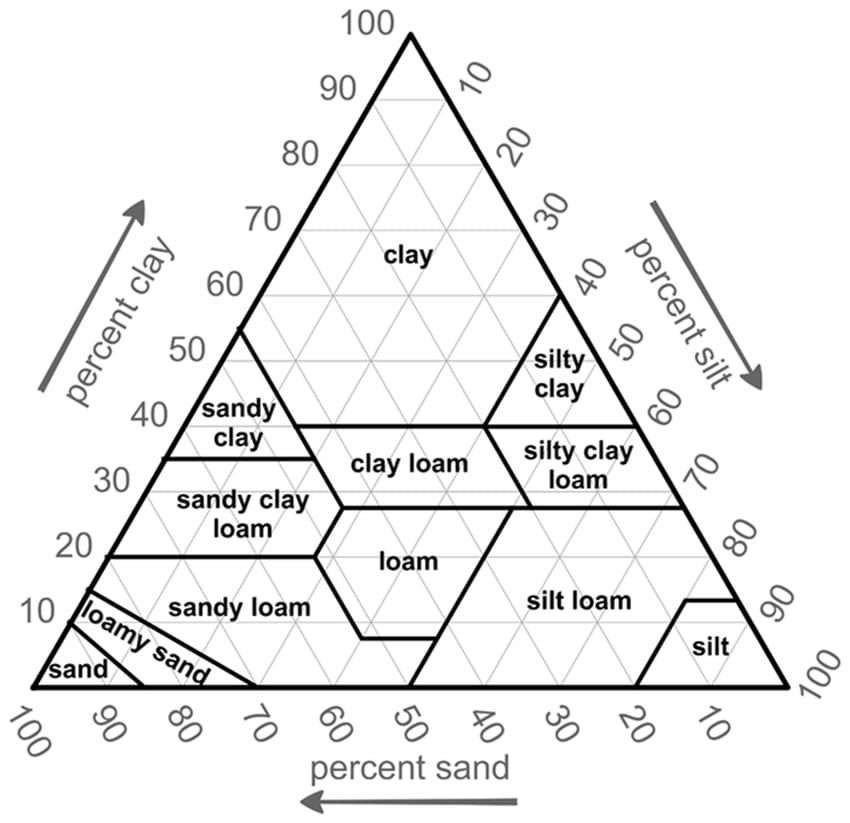
Textural classes:
Total 12 textural classes but 3 are main i.e. sand, silt, and clay.
- Sandy soil: Soil contains more than 85% sand.
- Silt soil: When more than 80% silt.
- Clay soil: When more than 40% clay
- Clay soils have highest pore space than other.
Classification of soil particles:
| Classification | According to ISSS (diameter in mm) |
| Gravel | >2.0 |
| Coarse sand | 0.2 – 2.0 |
| Fine sand | 0.02 – 0.2 |
| Silt | 0.02 – 0.002 |
| Clay | <0.002 |
Loamy soil:
- These are best for agricultural production (especially sandy loam) because they retain more water and nutrients than sandy soils and have better drainage, aeration and tillage properties than clay soil.
- Suitable for most of the crops.
Heavy soils:
- The clay soil imparts cohesion and stickiness and fine texture to the soil and induces resistance to the passage of implements.
- In other word it makes the soil heavy.
- These soil are suitable for cotton, rice and sorghum.
Light soil:
- In comparison to clay soil sandy soils offer little resistance to implements and called light soil.
- Example light soils suitable for groundnut, potato, tabacco and legumes.
Hence:
- The term heavy and light refers to the degree of resistance offered by soil to the passage of implements.
- But not to weight in fact the heavy soil weight less than an equal volume of the light soil.
Soil structure:
- Refers to the arrangement or grouping of primary soil particles viz., sand, silt, clay and their aggregates into certain pattern is called soil structure.
- It refers to the physical shape of the soil aggregates.
- Soil structures can be changed or altered by agronomic practices i.e. ploughing, cultivating, drainage, liming and manuring.
- The primary particles sand, silt and clay usually occur grouped together in the form of aggregates.
- Natural aggregates are called Peds.
- Clod: It is used for a coherent mass of soil broken into any shape by artificial means such as tillage.
Classification of soil structure:
- Structure is studied in the field under natural conditions and it is described under three categories.
- Type: Shape or form and arrangement pattern of peds.
- Class: Size of Peds.
- Grade: Degree of distinctness of peds.
Classes of Soil Structure:
Each primary structural type of soil is differentiated into 5 size classes, these are:
- Very fine or very thin.
- Fine or thin
- Medium
- Coarse or thick
- Very coarse or very thick
Grades of Soil Structure
- Grades indicate the degree of distinctness and durability of the individual peds.
- It is determined by the stability of the aggregates.
- Grade of structure is influenced by the moisture content of the soil.
- Grade also depends on organic matter, texture etc.https://hortigyan.com/