Introduction:
Insect morphology is the branch of entomology which deals with the external structure, form, shape, size and arrangement of body parts of insects. It helps in the identification, classification, and understanding of the growth, adaption, and behaviour of different insect species.
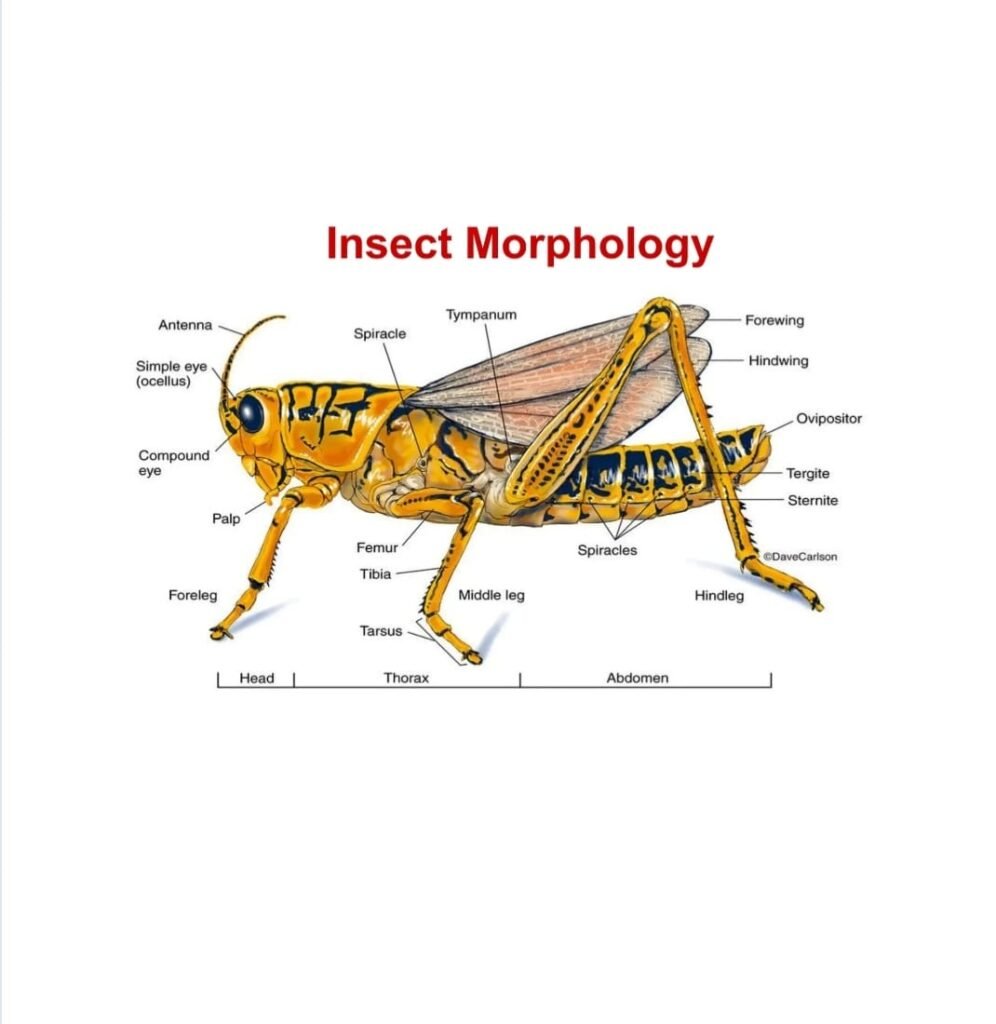
The body of an insect is covered by a hard exoskeleton made of chitin and is divided into three main regions: head, thorax, and abdomen. The head bears sensory organs and mouthparts, the thorax carries the legs and wings, and the abdomen contains the digestive, excretory, and reproductive organs.
The study of insect morphology is essential in agriculture, horticulture, and pest management because it helps identify beneficial and harmful insects, understand their life cycle, and develop effective pest control strategies.
Table of Contents
Body wall (Integument) of Insect:
- It is chitinous exoskeleton.
- It is the outer most covering of insect and it has one of most distinctive feature is to serve as exoskeleton as a frame work for attachment of muscles and barrier for retarding loss of water from of water from outer surface of insect body.
The structure of integument:
- It is divided in to three layers i.e. cuticle, epidermis (hypodermis) and basement membrane.
- Cuticle:
- It is outer most layer of integument.
- It is made up of chitin (25-60%) and protein (25-40%).
- It is non-cellular non-living layer and secreted by hypodermis
- Cuticle is further divided in to epicuticle and procuticle.
- The epicuticle is made of non-chitinous protein layer.
- The procuticle is having chitin and protein layer.
- Chitin: It is nitrogenous polysaccharides (carbohydrates) consist of several chains of acetyl glucosamine and glucosamine residue.
- Arthropodin: The main structural proteins of insect are known as arthropodin. It is untanned protein that is water insoluble.
- Sclerotin: It is tanned protein that is water insoluble.
- Resilin: Elastic protein responsible for the flexibility of wings sclerities.
- Epidermis (Hypodermis):
- It is second layer of the body wall beneath cuticle
- It is unicellular and active layer of body wall.
- The main function of epidermis is to secrete cuticle
- Basement menbrane:
- It is the outermost non-cellular layer of insect integument to which muscles are attached.
Moulting:
- The casting (shedding) of old cuticle is known as Moulting.
- It is necessary to growth of insect.
- It has two process the apolysis and ecdysis.
- Apolysis: It is beginning process with separation of old cuticle from underlying epidermal cells.
- Ecdysis: It the ending process of moulting with separation of old remain cuticle.
The insect body is divided in to three segments:
The Head, Thorax, and Abdomen
- The insect head:
- On the basis of classical theory (embryonic studies) insect head is made from six segments.
- Insect head bears one pair of antenna, a pair of compound eye and mouth parts.
- Thorax:
- It consists of 3 segments i.e. prothorax, mesothorax, and metathorax, usually two pairs of wings are present on meso and metathorax which is collectively known as pterothorax. Each segment of thorax carries one pair of legs hence; three pairs of legs are present.
- Abdomen of instects:
- It has 10-11 ring segments except collembolla which has 6 abdominal segment, while protura has 12 abdominal segment.
- Abdominal segments of pterygote insects are divided in to pregenital segments (first 1-7 segment).
- The 8th and 9th segments are regarded as genital segments because on the 9th abdominal segment, the male genitalia is found while 8th and 9th segments are collectively form genitalia e.g. in grasshopper.
- Remaining 10th and 11th segments have post have post genital appendages like cerci (a pair of sensory organ located on the tail region of insects) and dorsally one epiproct and laterally two paraproct (sclerotized plate like structure of ovipositor is found on the 10th or 11th abdominal segment of female grasshopper).
- The larvae of pterygote insects have locomotory structure which is known as prolegs. In lepidopteran larvae 1- 5 pairs of prolegs (with crochets) and in mustard saw fly 8 pairs of prolegs (without crochets) are present on the abdomen.
- In aphids, on dorsal side of the 5th and 6th abdominal segment have cornicles which release honey dew substance. https://www.slideshare.net/slideshow/insect-morphology/262991693