Introduction:
Soil moisture constraints refers to the limitations caused by either insufficient or excessive water in the soil that adversely affect the plant growth, crop productivity, and soil health. Soil moisture is essential for seed germination, nutrient dissolution and uptake, microbial activity, and various physiological process in plants. When the soil does not maintain an optimum moisture level, crops experience water stress, reduced nutrient availability, poor root development, and lower yields. Factors such as irregular rainfall, drought, poor drainage, soil texture, compaction, and climate change contribute to soil moisture constraints.
Effective soil and water management practices, including irrigation scheduling, mulching, conservation tillage, and proper drainage, are essential to overcome these constraints and ensure sustainable agricultural production. https://agritech.tnau.ac.in/agriculture/agri_reosurcemgt_soil_soilcontraints.html
Table of Contents
Metric potential:
- The total water potential that is attributed to the solid colloidal matrix of the soil system.
Capillary potential:
The energy with which water is held by soil is defined in terms of capillary potential.
Seepage:
- Horizontal flow of water channel is called seepage.
- Water loss from the irrigation channel or canal is mainly dur to seepage
Percolation:
Down ward movement of water through saturated or nearly saturated soil in response to the gravity.
Infiltration:
- Entry of water from the upper layer of soil is called infiltration.
- It occurs in unsaturated soil.
Leaching:
Downward movement of nutrients and salts from the root zone with the water is called leaching.
Saturation capacity:
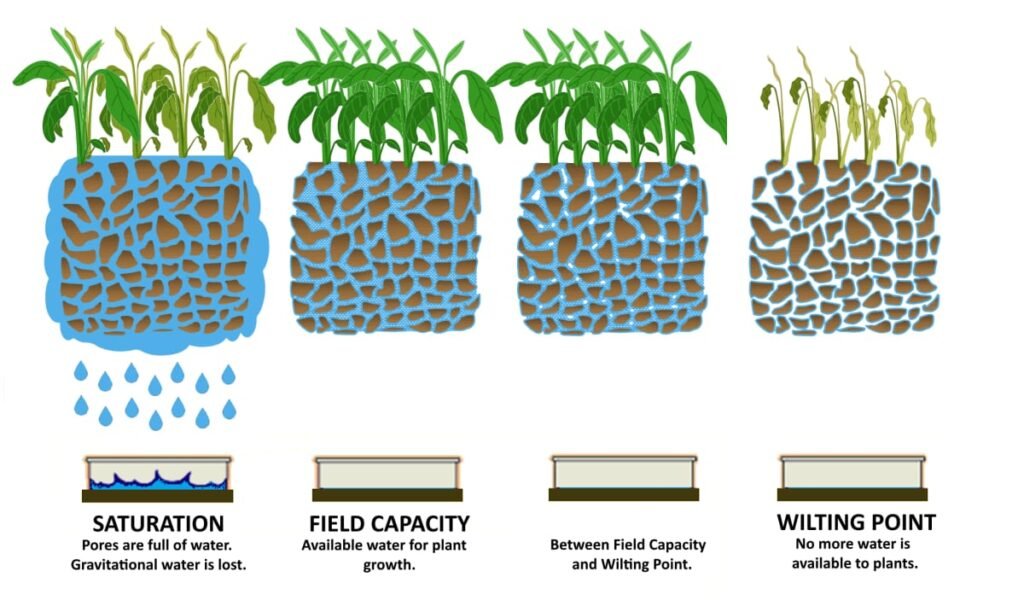
- When all the soil pores are filled with water at a tension zero “0” bars is termed as saturation capacity.
- It is called as maximum water holding capacity.
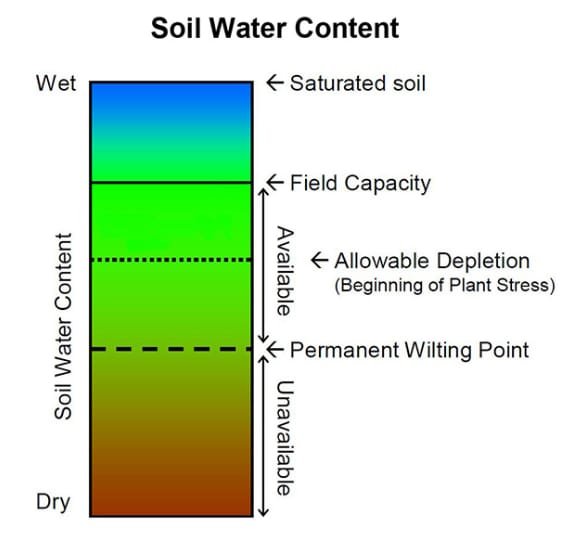
Field capacity:
- The soil moisture content after 2-3 days of irrigation and after drainage of gravitational water has become very slow and soil moisture content had become relatively stable.
- At the field capacity, the large pores filled with air and the micro pores are filled with water.
- It is considered as the upper limit of water availability to plants.
- The tension at field capacity ranges from -0.1 to -0.33 (1/3) Atm.
- It is determined with the help of pressure plate apparatus.
Permanent wilting point (PWP)
- The concept permanent wilting point (PWP) proposed by Briggs and Shantz in 1912.
- They utilized dwarf sunflower as an indicator plant.
- Soil moisture content at which plants can be no longer obtains enough moisture to meet their requirement and remained wilted unless water is added to the soil.
- It is the lower limit of available water to plant.
- Although plants not dead, but they are now in a permanently wilted condition and die if water is not added.
- Soil moisture tension at PWP is about -15 bars or 15 atmosphere.
Wilting coefficient:
- The percentage of moisture in root zone at the permanent wilting of plants is called the wilting coefficient or critical moisture point.
Available water:
- Concept of available water given by Veihmayer and Hendrickson 1981.
- It is the soil moisture available for maximum plant use.
- It is the portion of capillary water help between Field Capacity to PWP (i.e. -0.3 to -15bars)
Ultimate wilting point:
- The moisture content at which wilting is complete and the plant die is called UWP.
- At UWP the soil moisture tension is as high as -60 bars.
pH:
- The term pH given by SPL Sorenson (1909).
- Defined as the negative logarithm of hydrogen ion activity.
- Log 1/(H+)
- Range: 0-14
- Acidic: <7
- Neutral: 7
- Basic: >7
- pF value: It is defined by Schoefild (1935)
- The logarithm of centimeter height of a water column to give the necessary suction.
- Expressed in centimeter of water (based on the height of a water column above free water level in cm).
| Soil condition | pF value | Pressure Atm/bars |
| Saturated soil | 0 | 0.001 |
| Field capacity | 2.53 | 1/3 |
| PWP | 4.18 | 15 |
| Hygroscopic point | 4.50 | 31 |
| Oven dry soil | 7.0 | 10000 |
- pF given by Silen:
- It is negative logarithm of electron activity.
- pE = Eh/0.0591
- It measure intensity of oxidation- reduction.