Introduction:
Problematic soils are soils that have physical or chemical properties which limit plant growth, reduce agricultural productivity, and require special management practices for successful cultivation. These soils often have issues such as excessive salinity, alkalinity, acidity, poor drainage, low fertility, or unstable structure.
India has a wide variety of problematic soils due to its diverse climate, geology, and topography. The major types include saline soils, sodic soils (alkali) soils, saline- sodic soils, acid soils, waterlogged soils, pest and marshy soils, and desert sandy soils. These soils are found in different regions of the country and affect millions of hectares of agricultural land. https://agrimoon.com/wp-content/uploads/Problematic-Soils-and-Their-Management.pdf
Table of Contents
Major Types of Problematic Soils:
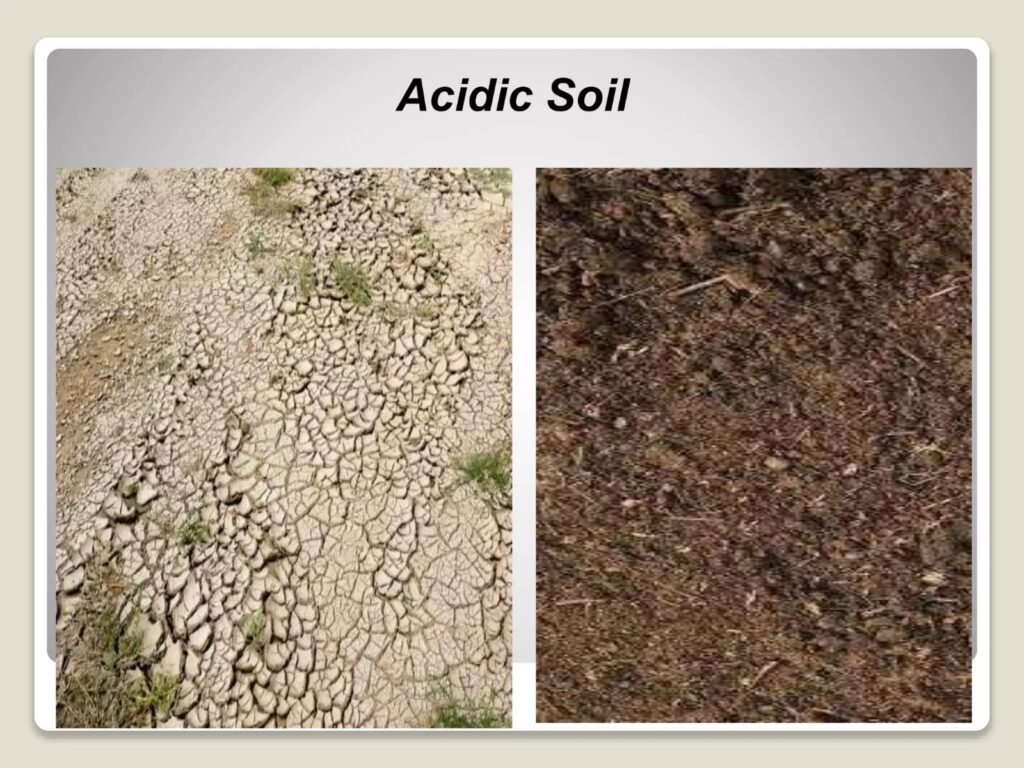
- Acidic soils:
- Higher acidic soils found in West Bengal, North- East states, Orissa, TN, Bihar.
- Acidity due to adsorption of H+, Al+3, Fe+2, Mn+2 ions on soil colloids.
- Acid soil management:
- Use of agriculture liming material such as oxide, hydroxide, carbonates, of Ca and Mg and use of rock phosphate, press mud etc.
- Acid soil management:
- Saline soils:
- Found white crust of salt hence called white alkali/solon chalk.
- Soluble salt i.e. Cl and SO4 ions of sodium and calcium in root zones.
- EC is used for measurement of soil salinity.
- Found in arid and semi- arid zones.
- Reclaimation of saline soil:
- Flooding or leaching of soluble salts by good irrigation water.
- Keep soil moist or frequent irrigated the field.
- Use of FYM for saline reclamination.
- Reclaimation of saline soil:
- Alkaline soils:
- Boron, Mo, and sodium toxicity in alkaline soils.
- Black colored, found in semi- arid and sub humid area.
- Developed due to excess NaCO3, and NaHCO3 ions in soil
- In alkali soils should be used CAN or DAP instead urea.
- Reclamation of alkali soil:
- Gypsum @ 8 qt/ha used for reclamation of sodic or alkali or soils having ph > 8.5.
- Iron pyrite (Fes2) @ 12 qt/ha can be used for amendments of alkali soil.
- Green manuring should be adopted.
- Cultivation of salt tolerant crops.
- Reclamation of alkali soil:
Relatively salt sensitive crops are:
| Crop | High tolerant | Medium tolerant | Sensitive crops |
| Field crops | Barley, dhaicha, sugarbeet, tobacco, cotton, mustard | Rice, sorghum, pearl, millet, arhar, wheat, rye, oat | Sunhemp, pea, groundnut, moong, gram, urd |
| Fodder crops | Rhodes grass, khushgrass | Sudan grass, berseem, lucerne, sorghum | Cluster bean |
| Vegetables | Spinach grass, sugar beet, B. repa | Cabbage, cauliflower, tomato, carrot, onion, potato | Sam, English varieties of raphanus |
| Fruit crops | Date palm, phalsa | Pomegranate, grapes, guava, mango, banana, ber | Apple, lemon, strawberry, almond |
- In case of saline soils Gypsum shouldn’t be recommended because sulphate ion gypsum also increase salt concentration of soil.
- Substances that influence the plant growth favorably by emulating the soil physical and chemical properties are called soil amendments.
Parameters of different problematic soils:
| Parameters | Saline soil | Alkaline soil | Saline- Alkali |
| pH | <8.5 | >8.5 | >8.5 |
| EC (ds/m) | >4 | <4 | >4 |
| ESP (%) | <15 | >15 | >15 |
Characteristics of problematic soils:
Problematic soils are soils that have physical, chemical, or biological properties that limit plant growth and reduce agricultural productivity. Their major characters include:
- Poor soil fertility: Deficient in essential plant nutrients.
- Extreme soil pH: Highly acidic (pH <5.5) or highly alkaline (pH >8.5).
- High salt content: Excess soluble salts in saline soils affect water uptake.
- Poor soil structure: Hard crust, compaction, and week aggregation.
- High exchangeable sodium: Sodic soils have poor structure due to excess sodium.
- Poor drainage: Waterlogging and low aeration restrict plant growth.
- Low water holding capacity: Common in sandy soils, leading to drought, stress.
- High clay content: Causes swelling, shrinking, and difficult tillage in some soils.
- Nutrient imbalance: Deficiency or toxicity of nutrients such as nitrogen, phosphorus, iron, zinc, or boron.
Nice 👍