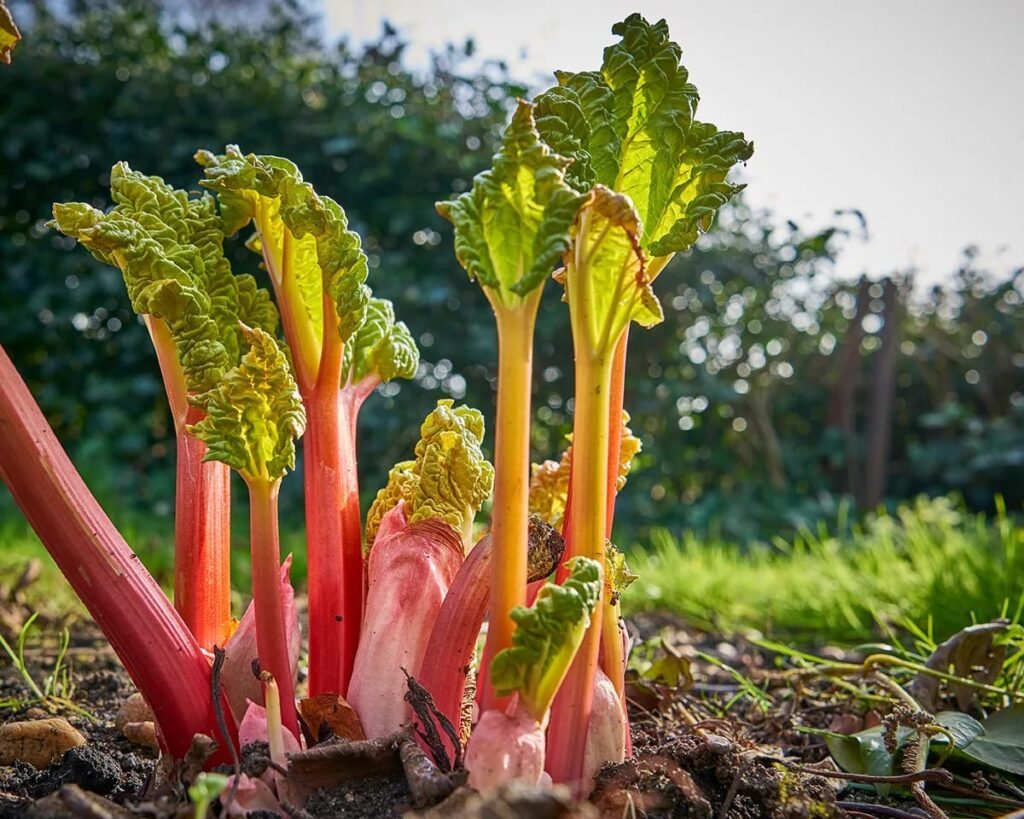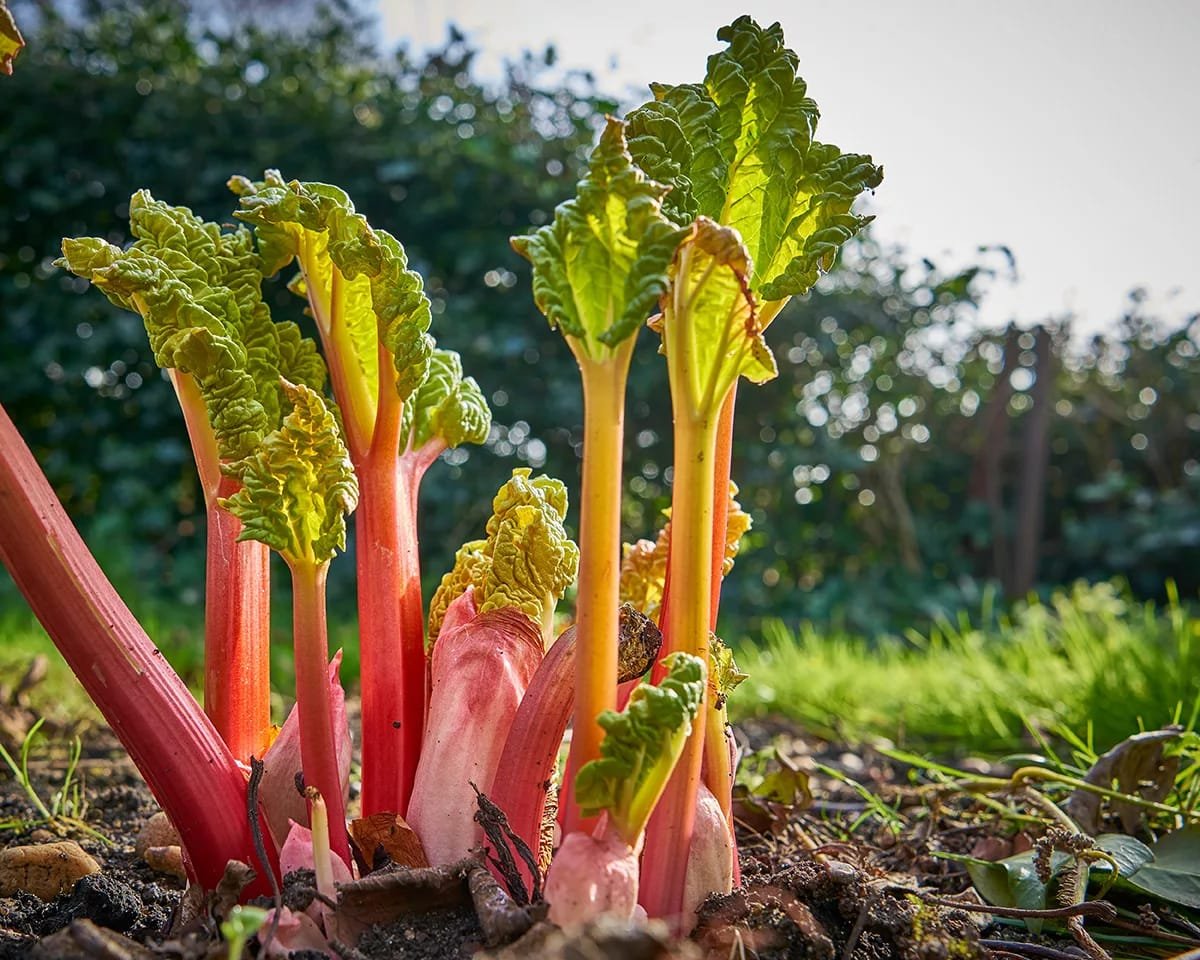
Rhubarb (Rheum rhaponticum L.) is a hardy perennial vegetable grown for its thick, fleshy leaf stalks (petioles), which are commonly used in pies, jams, sauces, deserts, and beverages. It belongs to the family Polygonaceae. Although it is often used as a fruit in cooking because of its tart flavor, botanically it is a vegetable.
Rhubarb is believed to have originated in Central Asia and Western China, where it was first cultivated for medicinal purposes. Today, it is grown mainly in temperate regions of Europe, North America, and parts of Asia. The crop thrives in cool climates and requires a period of winter chilling for proper growth.
Introduction
- Botanical name: Rheum rhaponticum
- Chromosome No.: 2n=4x=44
- Family: Polygonaceae
- Origin: Temperate Asia, probably Siberia
- Edible Part: Large thick leaf stalk or petiole.
Table of Contents
Botany
- Rhubarb is a herbaceous perennial vegetable with large fleshy underground rhizome having a fibrous root system.
- The economic part is the large thick leafstalk or petiole.
- Inflorescence: Panicle
- Flowers: Small greenish-white flowers are borne in panicles, which emerge successively. Since they are protandrous, self-pollination within a flower does not take place. Lower flower are fertilized by pollen from upper flowers.
Varieties
- Oldest varieties (Green stalk cultivars) are: Victoria and Linnaeus.
- New varieties (Red stalk cultivars) are: Mc Donald, Ruby Valentine, Sunrise, Strawberry and Cherry Red.
Climate
- Rhubarb is a cold resistant plant.
- The critical low temperature would be 3.3 ºC below the vegetative parts of the plants are killed.
- Similarly when the temperature goes above 23.9 ºC during summer and below 4.5 ºC during winter the plant does not grown well.
Soil
- A well drained loamy soil with good organic matter would be the most ideal soil for rhubarb.
- Though it tolerates soil-acidity to certain extent neural soil would be the best for the growth.
Propagation
- Through rhubarb can be propagated through seeds, it is not recommended, as the seeds do not give rise to true-to-type plants.
- It is propagated by the division of crowns. Each crown should contain good strong buds.
- Where the freezing temperatures are common, the crowns are planted in spring.
- Where the temperature is not freezing, the crowns are planted in autumn
Planting
- The crowns with buds are planted 5 cm below the soil surface.
- A spacing of 1.2-1.8 m has to be given between rows and the spacing between plants within a row has to be 0.6-1.2 m.
Manures and Fertilizers
- Soil with low organic matter should be supplied with well rotten organic manure @ 50 tonnes/ha before ploughing.
- It is supplemented with 100-150 kg of each NPK.
- During first year the nutrients are incorporated in to the soil just before planting in the bottom of the furrows.
Intercultivation
- Weeds to be controlled by frequent shallow cultivation before sprouting. If weeds have to be removed after sprouting, care should be taken to avoid injury to buds.
Harvesting
- Rhubarb is harvested from the second year of planting.
- During harvesting the stalks are pulled (they are not cut) and then the leaf blades are cut off.
- Harvesting can be done for a period of 8-10 weeks every year.
- The plants can be retained in the field for about 10-12 years.
- After harvesting stalks are washed with the water and then tied in bunches of 0.5 kg for local market.
Seed rate and yield
- Seed rate: 3-5 kg/ha.
- Plant spacing: 90 * 90 cm or 100 * 100 cm
- Yield: 20-30 tonnes/ha/year under good management. Mature plantation can produce 30-40 tonnes/ha in favorable conditions.
Commercial rhubarb is more commonly propagated by crown (root) division rather than seed because it ensures uniform plants and earlier production.
https://extension.umn.edu/vegetables/growing-rhubarb