Introduction:
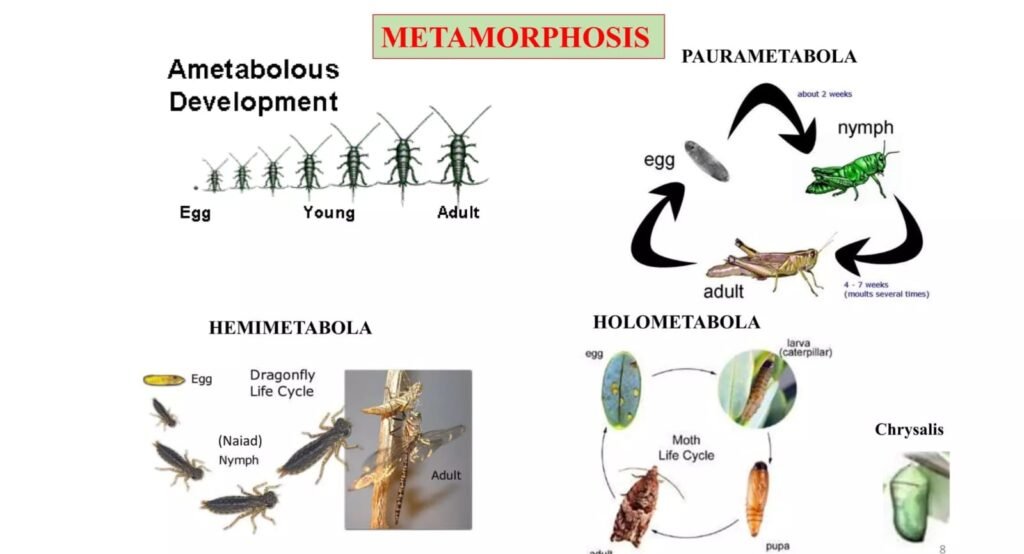
Metamorphosis is a series of changes that take place during the development of insects from eggs to adult are collectively known as metamorphosis.
https://www.slideshare.net/slideshow/metamorphosis-and-diapause-in-insectspptx/260357957
Table of Contents
Types of Metamorphosis:
- Ametamorphosis: Insects do not undergo any metamorphosis e.g. apterygotes.
- Incomplete or direct metamorphosis: It is also known as simple or hemimetabolous metamorphosis. In this type life cycle has three stages i.e. eggs, nymph, and adult and insects wing develop externally so these are called ‘Exopterogota’ e.g. Hemiptera (grasshopper), Isoptera, Orthoptera and Thysanoptera (it is link between indirect and direct metamorphosis because in some families of Thysanoptera pupa may or may not be present).
- Complete or indirect metamorphosis: This is also known as holometabolous because it has fore stages i.e. egg, larva, pupa and adult in their life cycle. Larvae have both thoracic and abdominal legs which is known as prologs except Diptera (in Diptera larvae is legless or apodous known as maggots). In these insect wings develop internally during pupal stage and are called ‘Endopterygota’ e.g. Lepidoptera, coleoptera, hymenoptera, diptera, neuropteran, strepsiptera, trichoptera etc.
- Hypermetamorphosis: Some insects have two or more types of larvae in the life cycle e.g. some coleopteran insects (blister beetle).
Insect Diapause:
In insects some stages undergo to diapause or dormancy by arresting growth or development during the physiological process of life cycle to avoid adverse environmental conditions. It may occur in any stage of life cycle.
- Egg stage: It is found in mango mealy bug and silk moth
- Larval diapause: It is found in maize stem borer, rice stem borer, and pink boll worm of cotton.
- Pupal diapause: It is found in red hairy caterpillar.
- Adult diapause: It is found in mango nut weevil.
Types of Larvae:
- Nymph: The immature stage of bugs, white fly, aphids, and jassids (order: hemiptera) and immature stages of grasshopper, locusts (order: orthoptera) are known as nymphs.
- Caterpillar: The larvae of butterflies, moths, bollworms, borers, loopers, and semiloopers (order: lepidoptera) are known as caterpillar.
- Grub: The larvae beetles, weevils (order: coleoptera) are known as grub.
- Maggot: The larvae of house flies, shoot flies, midges (order: diptera) are legless and known as maggots.
Insect Physiology:
- It includes physiology and biochemistry of insect organ systems.
- Father of insect physiology: V. B. Wigglesworth.
- The book ‘Principles of Insect Physiology’ is written by: V. B. Wigglesworth and he worked on kissing bug, Rhodnius prolixus.
Digestive system of insects:
- Alimentary canal:
- It is a simple hollow tube like structure which extends from the buccal cavity (mouthpart) to annus.
- It is divided into three regions:
- Fore gut (stomodaeum):
- It is anterior region of alimentary canal and ectodermal in origin
- It is primary organ of ingestion and storage of food.
- It consists following parts:
- Pharynx:
- It is the region between mouth and oesophagus.
- It form well developed sucking pump in fluid feeders.
- Oesophagus:
- It is second part of fore gut and undifferentiated tube just after pharynx.
- Its function is to receive food from pharynx and pass to crop.
- Crop:
- It is bag like structure and act as storage of food.
- In honey bees crop is known as honey stomach (whether nectar conversion occurs or honey formation takes place).
- Gizzard:
- It is posterior part of fore gut joined to mid gut.
- Function as grind the food and pass to mid gut.
- Pharynx:
- Mid gut/stomach/ventriculus:
- It is endodermal in origin.
- It’s primarily concerned with secretions of enzymes and digestion and absorption of food.
- It extends from end of gizzard (hepatic caeca) to anterior part of hind gut (Malpighian tubules).
- In mid gut intima i.e. cuticular linings are absent and form peritrophic membrane to protect mid gut epithelium from rough food particles especially in solid feeders.
- Hind gut/Proctodeum:
- It is ectodermal in origin.
- Extends from posterior end of mid gut to anus.
- Fore gut (stomodaeum):