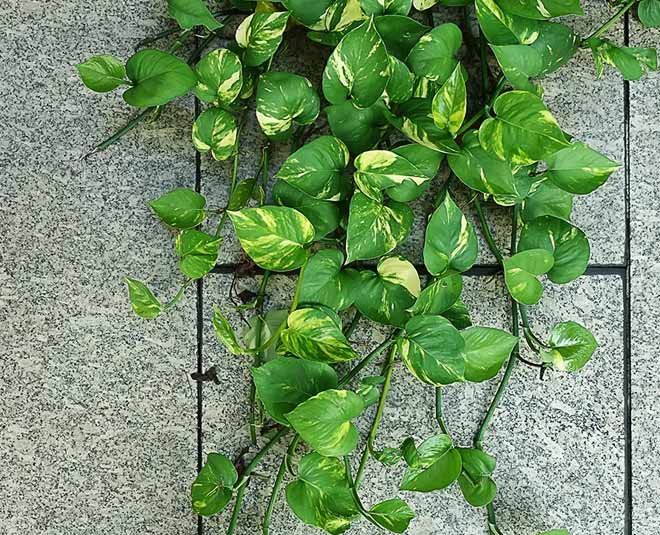
Money plant is a popular ornamental foliage plant grown mainly for it’s attractive leaves, easy maintenance, and ability to grow under indoor as well as outdoor conditions. It is commonly called Money Plant, Devil’s I’ve, or Golden Pothos.
Table of Contents
Introduction:
Money plant is a perennial, evergreen, climbing or trailing vine. It is one of the easiest ornamental plants to propagate and maintain.
Taxonomy:
- Botanical name: Epipremnum aureum
- Family: Araceae
- Common name: Money plant, Golden pothos, Devil’s ivy
- Nature: Evergreen perennial vine
- Growth habit: Climber/trailer
- Main purpose: Indoor decoration, landscaping, hanging baskets and vertical gardens.
- Propagation: Mainly by stem cuttings.
The plant traditionally called “money plant” in India is generally Epipremnum aureum. Several other plants may also be sold under the common name money plant.
Origin and Distribution:
Money plant is native to the Solomon Islands of the South Pacific. It us now widely cultivated as an ornamental plants throughout tropical, subtropical and warm regions.
Botanical Classification:
- Kingdom: Plantation
- Division: Angiosperms
- Class: Monocotyledonae
- Order: Alismatales
- Family: Araceae
- Genus: Epipremnum
- Species: E.aureum
It is especially popular because it can tolerate low light conditions better than many ornamental plants.
Botanical Description:
Root:
- Fibrous/adventitious root system.
- Produces aerial roots from nodes.
- Aerial roots help the plant climb and absorb moisture.
Stem:
- Soft, green and succulent when young.
- Becomes thicker with age.
- Contains distinct nodes and internodes.
- Can climb on a support or trail downward.
Leaves:
- Simple and heart-shaped.
- Usually green, yellow-green or variegated.
- Leaf size increases when the plant receives good growing conditions.
- Variegated forms have attractive yellow or white patterns.
Flowers:
- Flowers are rarely produced under normal indoor conditions.
- Inflorescence is a spadix surrounded by a spathe, typical of the Araceae family.
Popular Types/Varieties:
Some commonly cultivated forms include:
- Golden Pothos: Green leaves with yellow/golden variegated, very popular indoor plant.
- Marble Queen: Green leaves with/cream variegation, Requires somewhat brighter light to maintain variegation.
- Neon Pothos: Bright yellow-green/neon leaves, attractive for indoor decoration.
- Jade Pothos: Almost completely green leaves, performs relatively well under lower light.
- Manjula Pothos
- Pearls and Jade
Climate:
Money plant grows best under warm and humid conditions.
Ideal conditions:
- Temperature: Around 18-30 ⁰C.
- Humidity: Moderate to high humidity is beneficial.
- Protect from: Frost, very cold temperatures, extremely hot direct sunlight, strong dry winds.
Light requirement: Money plant is often described as a low-light plant, but this doesn’t not mean it needs complete darkness.
Best condition: Bright, indirect light – healthy growth and good leaf colour.
Direct harsh afternoon sunlight may cause:
- Leaf scorching
- Yellowing
- Browning of leaves
Soil and Growing Media:
Money plant requies a well-drained, porous and fertile growing medium.
Suitable mixture:
A simple potting mixture can contain:
- 40% garden soil
- 30% cocopeat
- 20% compost/vermicompost
- 10% sand/ perlite
The exact ratio can be adjusted depending on the material available.
Important properties:
The medium should be:
- Well drained
- Rich in organic matter
- Porous
- Moisture-retentive but not waterlogged
- Slightly acidic to neutral
A pH around 6.0-7.0 is generally suitable
Container Selection:
Choose a container with drainage holes at the bottom.
Suitable container include:
- Plastic pots
- Ceramic pots
- Cement pots
- Hanging baskets
- Glass containers for water propagation.
For soil Cultivation, drainage holes are particularly important because stagnant water can cause root rot.
Propagation:
Money plant is mainly propagated through stem cuttings.
Stem Cutting Method;
- Select a healthy mother plant choose a vigorous plant free from pests and disease.
- Take the cutting remove the lower leaves, keeping some leaves at the top.
- Rooting: the cutting can be planted kn cocooeat, sand, potting mixture, water
- Maintain moisture: keep the medium moist but not waterlogged.
- Root development: roots generally develop from the nodes. Once sufficient roots develop, the cutting can be transferred to a suitable potting mixture.